Infinite Expansion of the Rubber Band Mansion
Solo Presentation of artwork by Jamie Isenstein
The ICA at the University of Tennessee at Chattanooga
November 4 to December 16, 2022
Curated by Rachel Waldrop
Work details and essay by Isabelle Loring Wallace below.
https://www.utc.edu/arts-and-sciences/ica-chattanooga/exhibitions/jamie-isenstein-infinite-expansion-of-rubber-band-mansion
Works in the exhibition:
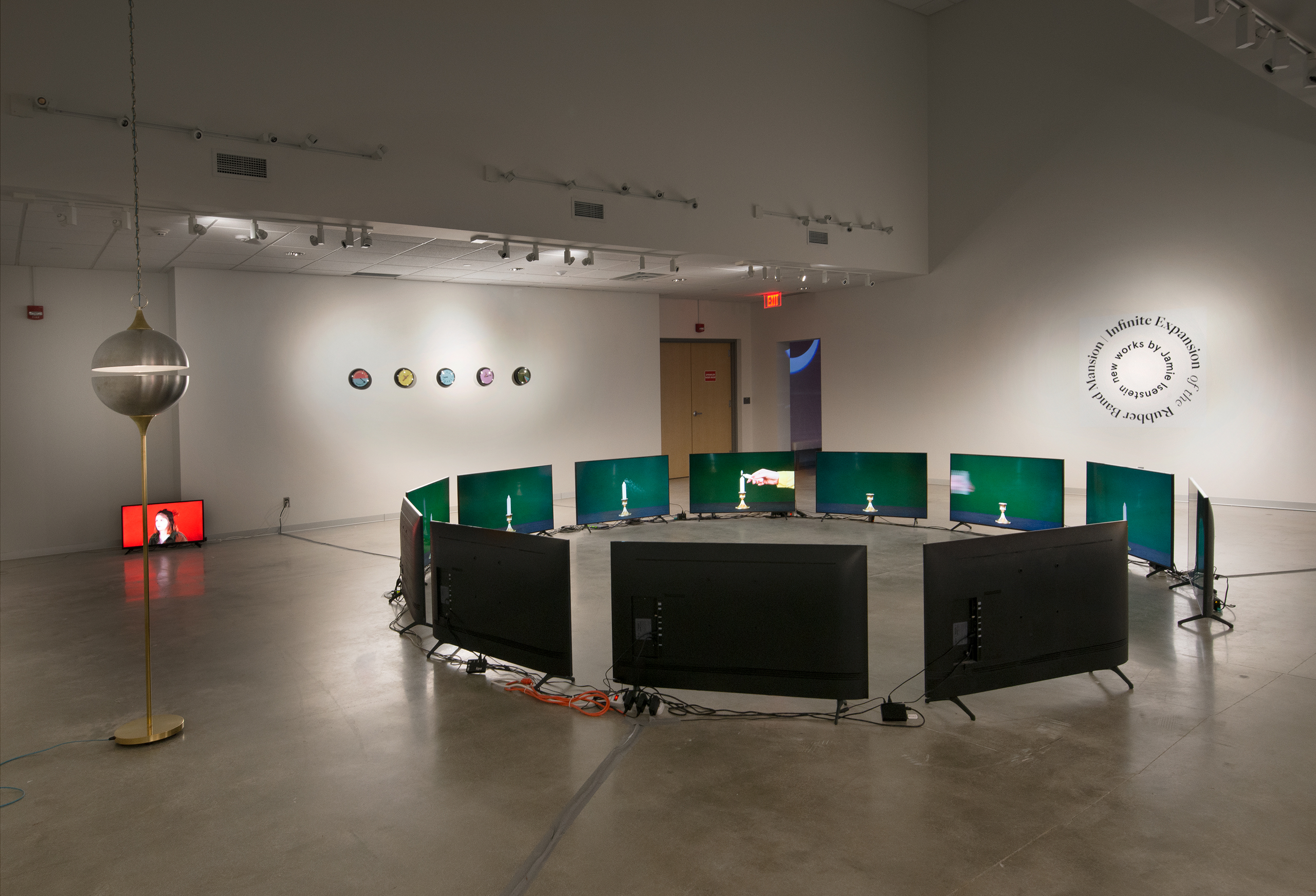
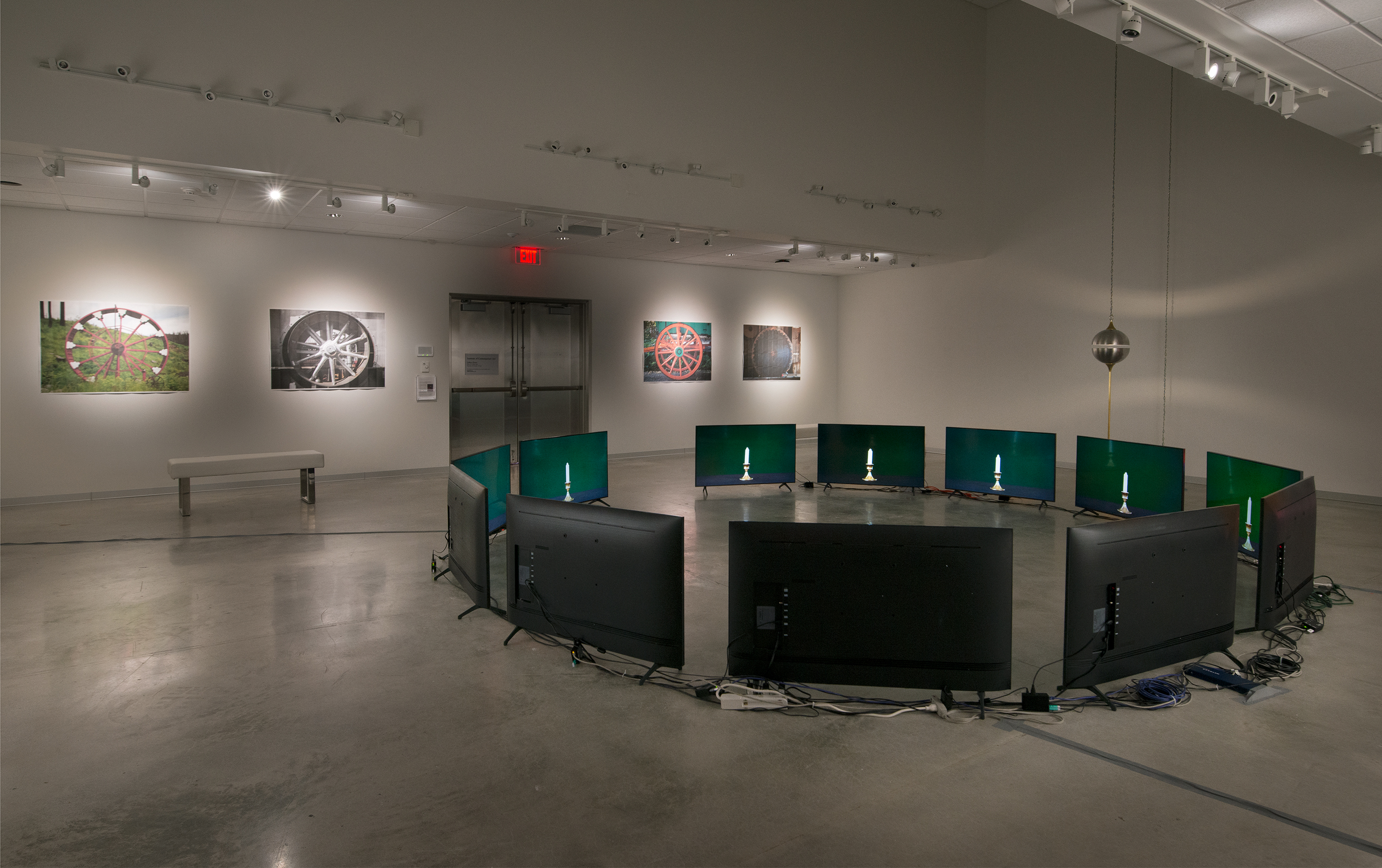
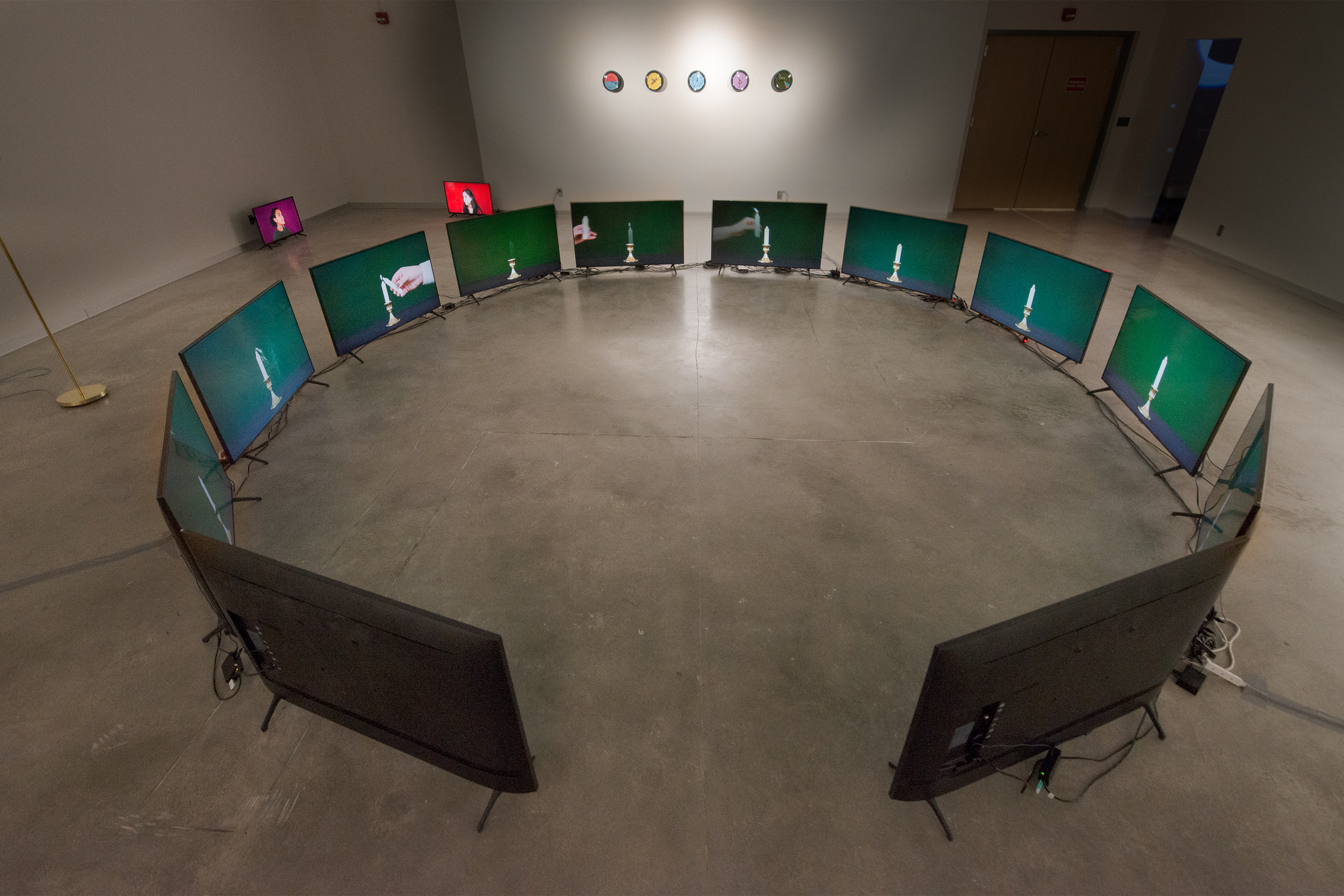
Candle Clock, 2022
12 channel video, looping playback devices
Dimensions variable
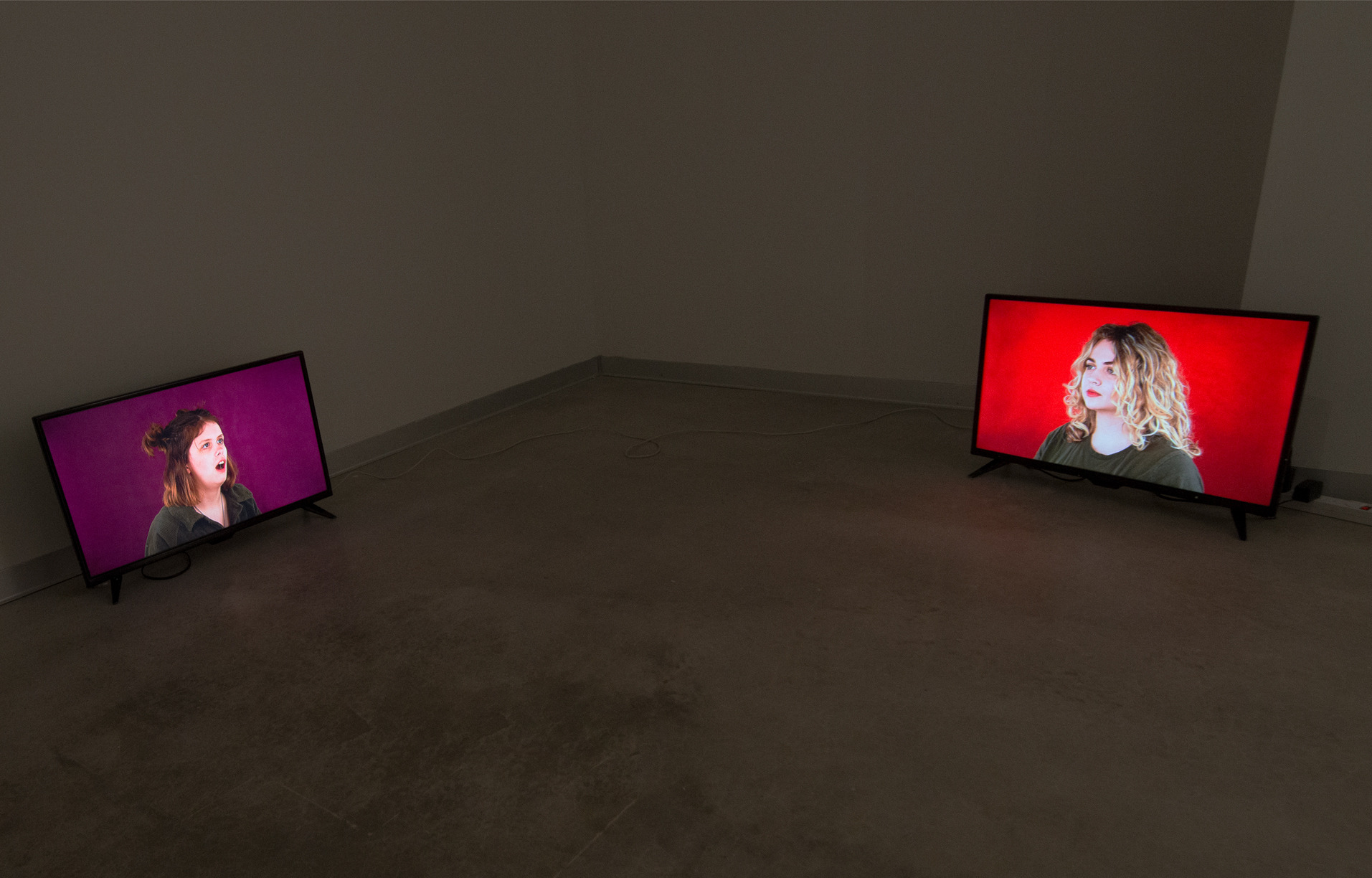
Unlimited Ping Pong (Yawn), 2022
2 channel video, looping playback devices
Dimensions variable
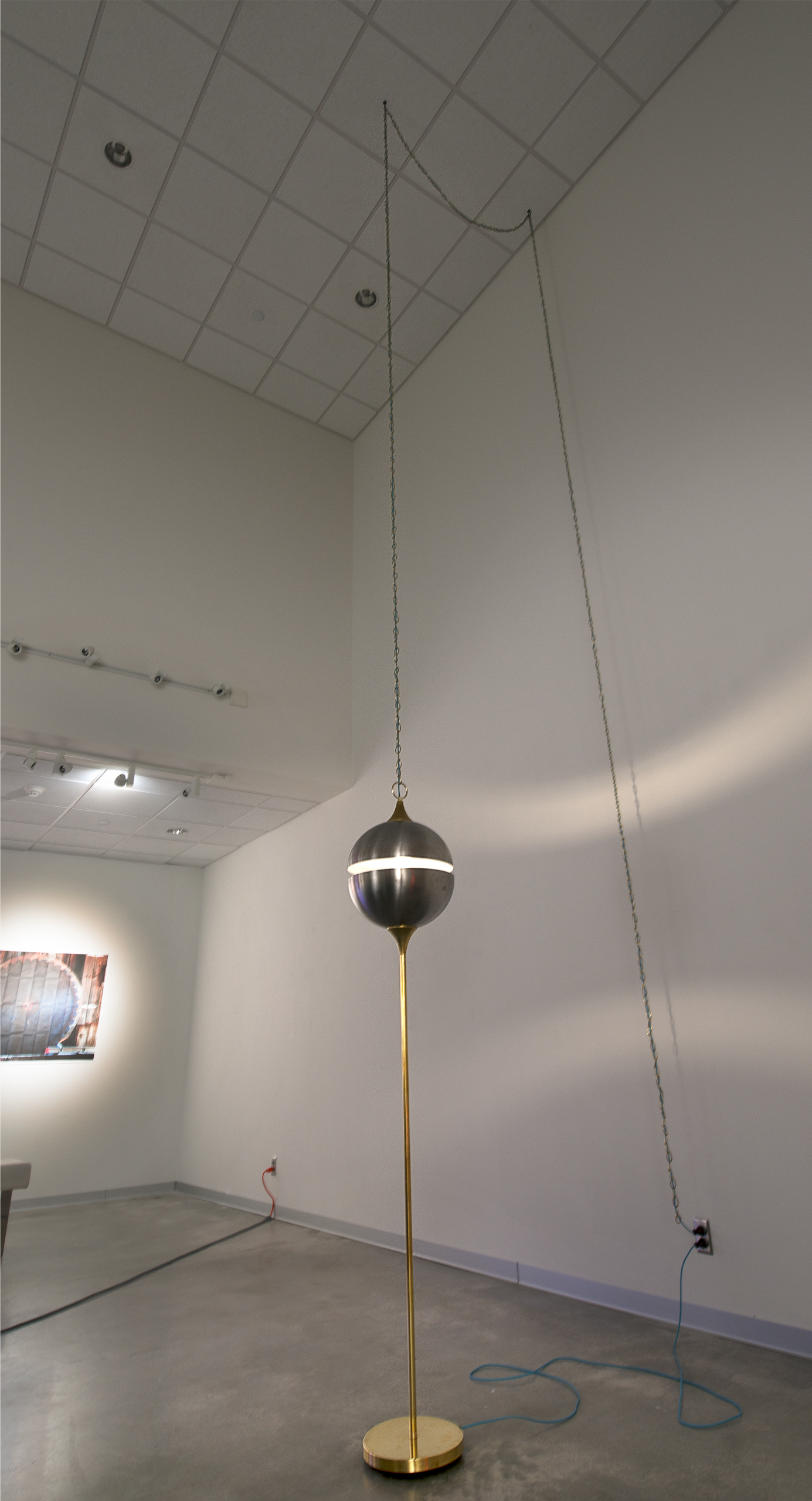
Loop of Light, 2022
Swag lamp, torchiere floor lamp, outlet, electrical grid
Dimensions variable
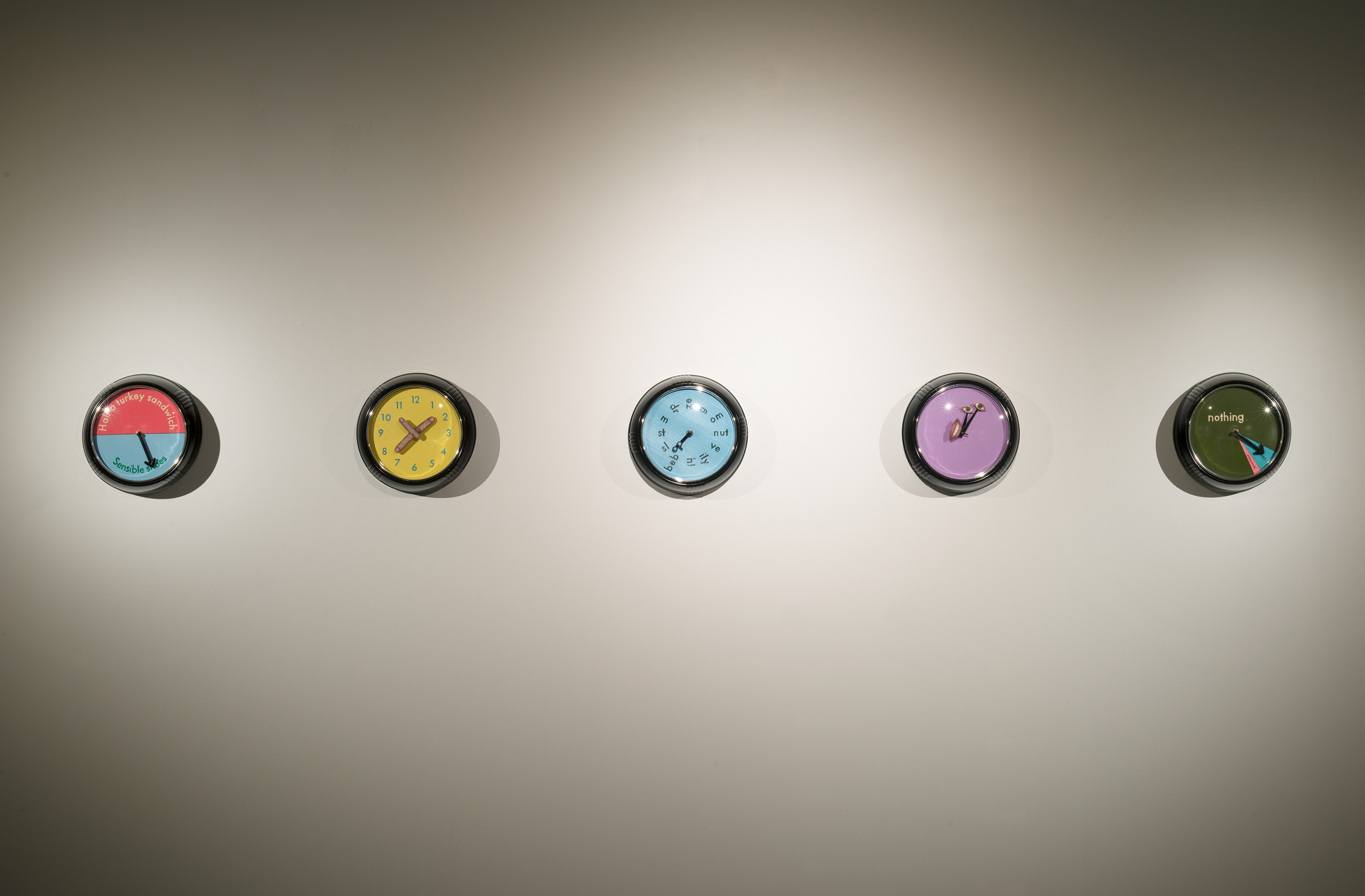
Mood Clocks, 2022
Five clocks, paint, wood, clock movements
9.5 x 9.5 x 2.5 inches each
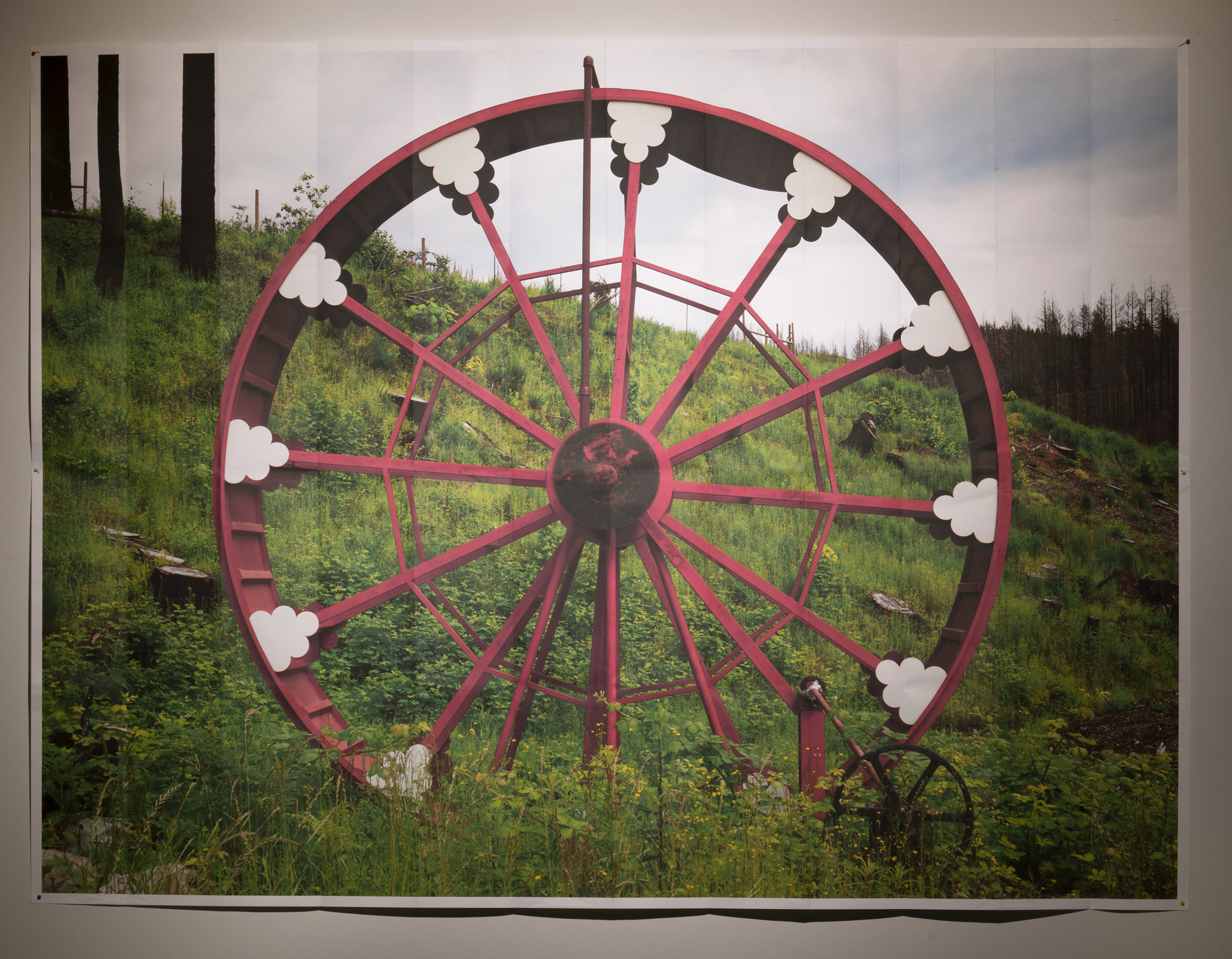
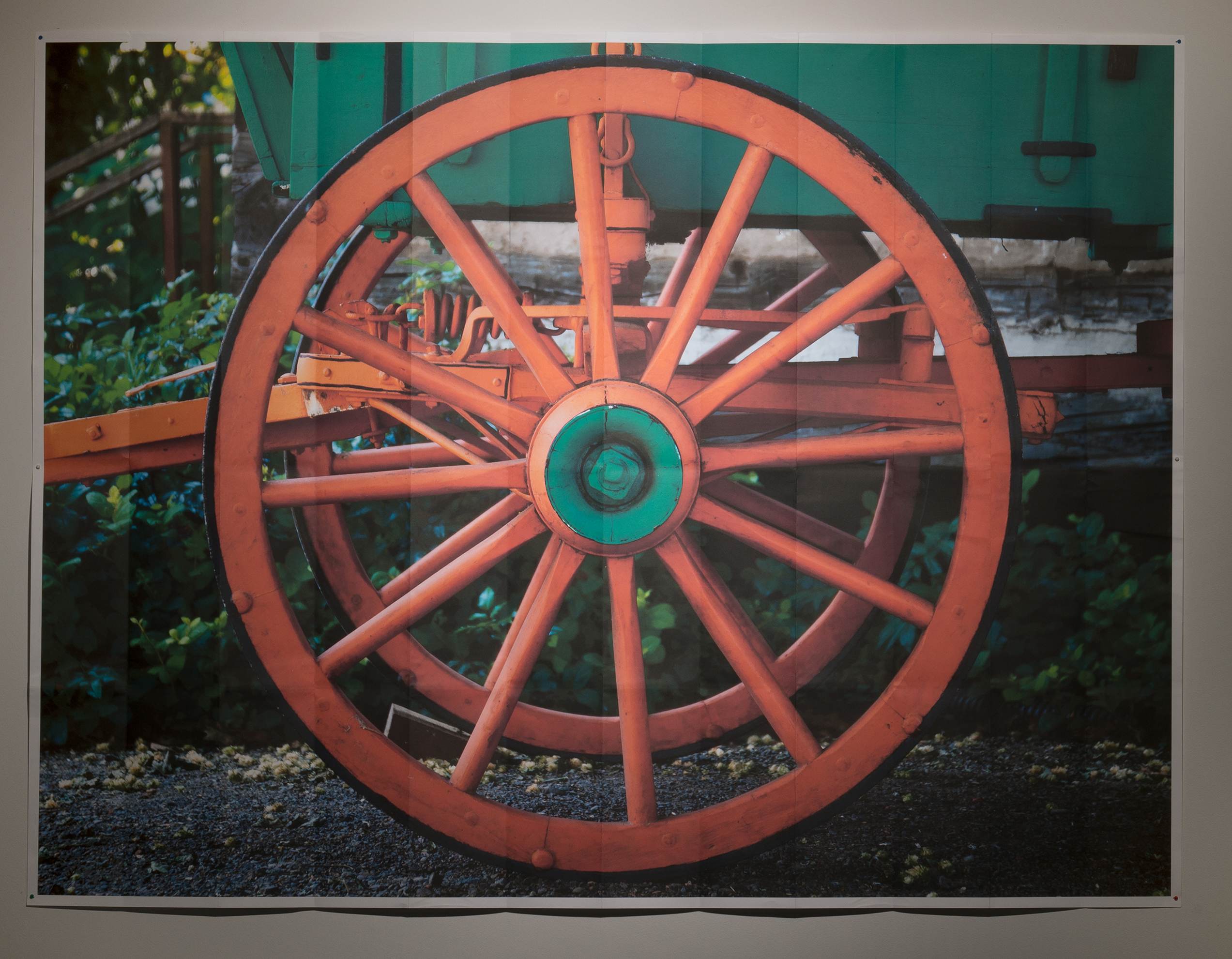
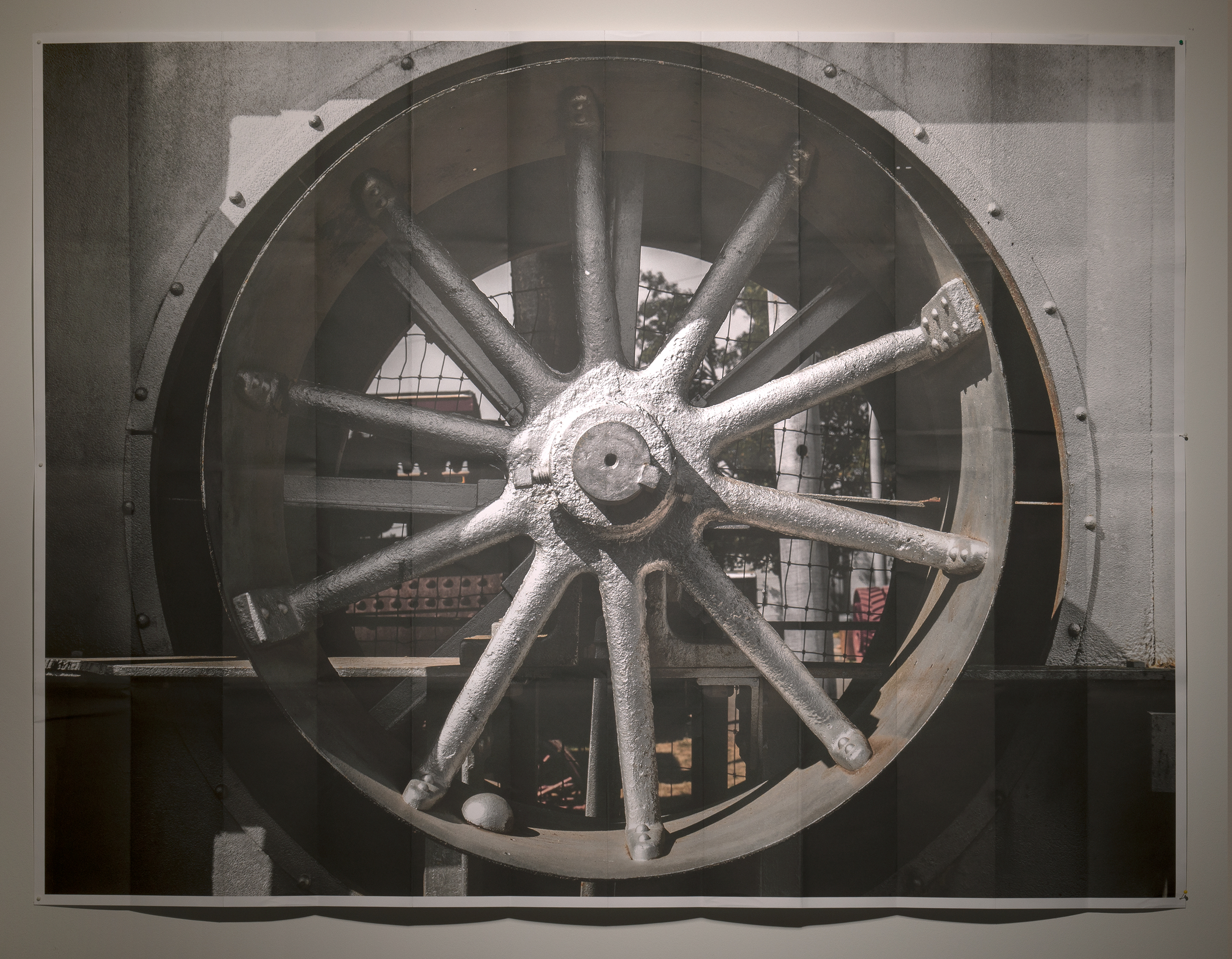
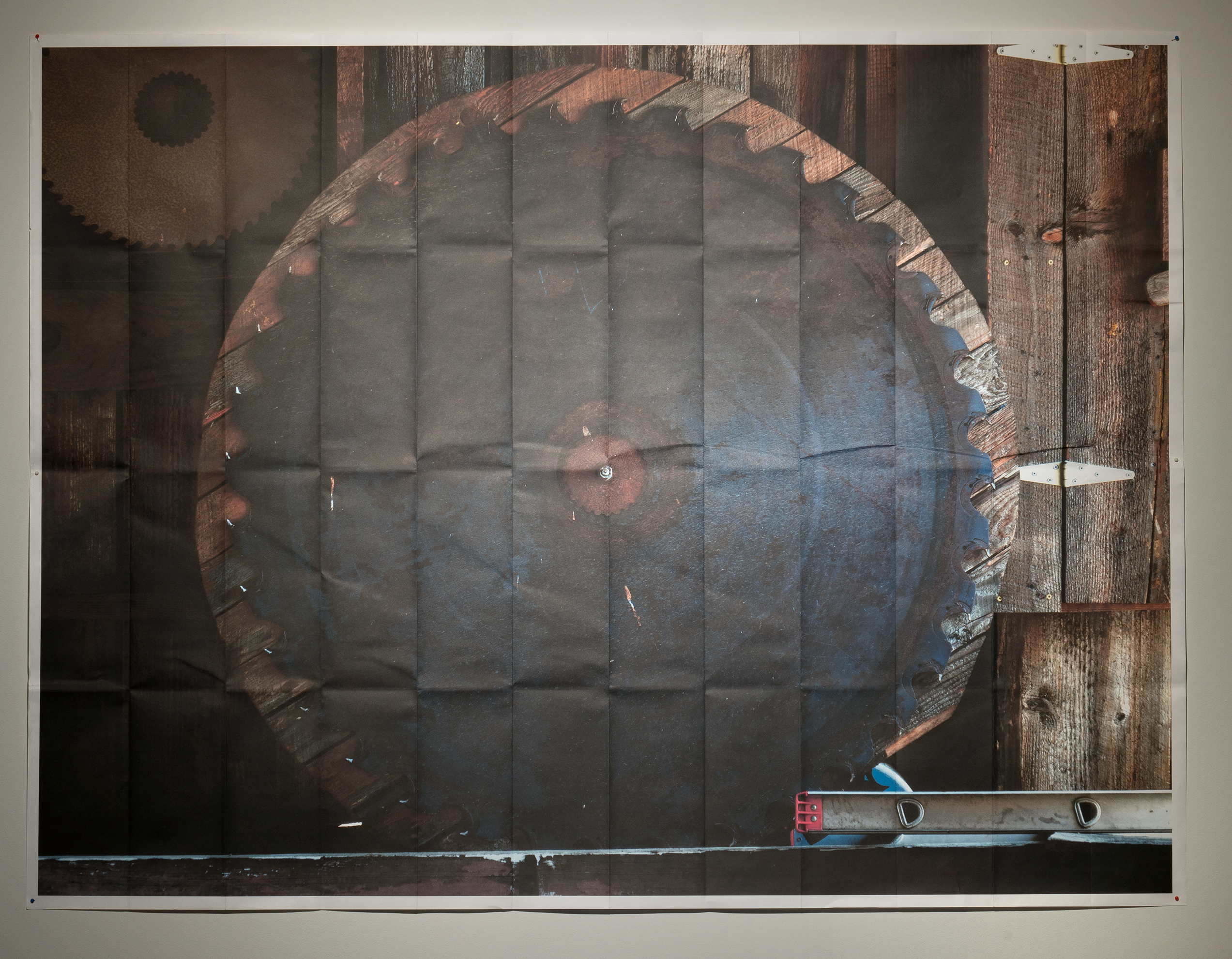
Wheels of Fortune (Water Wheel, Silver Motor, Orange Wagon Wheel, Lumber Mill Saw Blade), 2022
Map made from folded Tigerbond paper
36 x 48 inches each
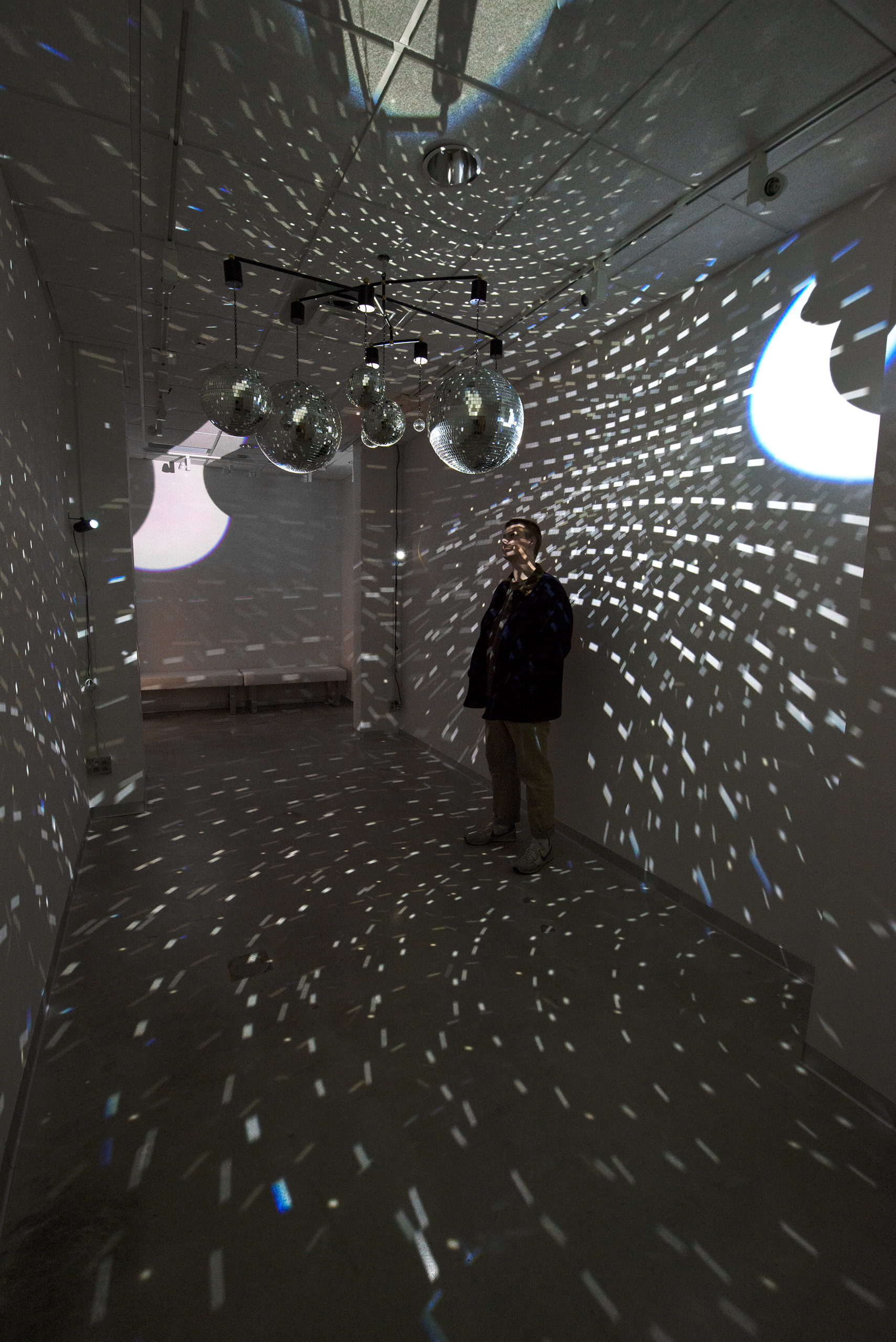
The Disco-Centric Model, 2022
Model of the universe made from disco balls, chain, wood, motors, spotlights
Dimensions variable
Full Circle
Essay by Isabelle Loring Wallace
University of Georgia, Athens
Boredom is a concept most artists wouldn’t want associated with their work, but I think
Jamie Isenstein might not mind. In fact, her exhibition at the ICA Chattanooga, Infinite
Expansion of the Rubber Band Mansion, includes one artwork that actively solicits the
physiological symptom most closely associated with this condition. Because of this, visitors
stimulated by Isenstein’s show—and the many complex ideas conjured by her videos,
sculptures, and wall works—will nevertheless find themselves, at some point, in the process
of yawning. But why? For what reason would Isenstein actively pursue a response that could
be seen, under other circumstances, as a condemnation of her efforts?
Called Unlimited Ping Pawn (Yawn), the piece in question shows across two monitors a near-
endless cast of characters (one per screen), who proceed over the course of a seemingly
infinite loop to catch “the yawns” from someone, only to then induce yawning in someone
new, who then appears, mouth agape, in an adjacent monitor. The piece in other words is
both a depiction of yawning and yawn contagion, and, in its own right, a yawn machine—that
is, a mechanism by which yawns are passed (both visibly and audibly) not only from person
to person on screen, but from the video to the spectator in the gallery. Consequently,
otherwise alert visitors are likely to find themselves sharply inhaling before slowly returning
their recycled air to the galleries, where it will invisibly mingle with the rest of the artworks
in the exhibition: rotating disco balls and strange clocks, a bewildering assortment of folded
and flattened photographs (all of wheels), a large-scale video installation featuring candles,
and an adjacent light-sculpture that reads as an alien birth, or the splitting of the atom, or
some other enigmatic, but importantly cosmic event. But, to ask again: amidst all of that,
what is the point of this theatrical, implicating flourish? Why, in this context, at once quirky
and profound, would Isenstein embed a yawn machine? Or to put that another way, why
would she effect in us the sign of boredom over and against the vitalizing experience of her
show? This essay—which considers Isenstein’s work against the backdrop of disco, Henri
Bergson, and the myth of Narcissus—is my brief attempt at an answer.
***
Of what does Isenstein’s exhibition consist? Spread across two darkened rooms, the show is
dominated by a large floor-bound installation that takes the form of an unconventional
clock, at once contemporary and anachronistic. Candle Clock (2022) is an immersive digital
experience consisting of twelve synchronized monitors arranged in a circle. As viewers stand
in the empty space they enclose, they watch as a lit candle is seemingly passed (and
extinguished and re-lit ad infinitum) from one hand and monitor to the next. As if in
defiance of Copernicus, then, it is the sun, or, in this case, a tiny atomic fragment, that
rotates around us, this galaxy’s notional center. Continuing an anthropomorphizing thread
found in Isenstein’s earlier work with candles (specifically Snuffer of 2008), this multi-
channel iteration simultaneously humbles the spectator by functioning as a high-tech
momento mori in which the body’s finitude is analogized to a burning candle and its easily
extinguishable flame.
Visible on a central wall just beyond Candle Clock are time pieces that are more
conventional in appearance, despite abandoning the familiar notion of time as an
unrelenting and impersonal force. Instead, they highlight the lived experience of time (la
durée, as Bergson called it), which is subjective, erratic, and at every moment tethered to
the psychology and physiology of the individual—in sum, time as one feels it, rather than as
invented, standardized, and subdivided into neatly identical units in Europe in the late
nineteenth century. How is this shift in emphasis achieved? In some instances, by replacing
the clocks’ faces and hands with, well…faces and hands, or more precisely, facial features
and fingers. In one Mood Clock, two eyes and a mouth affixed to the ends of the hour,
minute, and second hands rotate in and out of alignment, resulting in facial configurations
that are both natural and the stuff of surrealist cartoons. In another, three variously
expressive fingers spin, as if to remind us that buried within mechanized time is another
kind of temporality related to psychology and feeling: one which inflects objective time from
within—slowing it, speeding it, disassembling it—even as the wall clock continues to
mechanistically spin. Still other (Mood) clocks in the exhibition remind us that clocks are
themselves an invention, and one whose essential configuration (a circle with lines that
rotate therein and subdivide it), might be otherwise deployed: as a toy, for example,
designed for word play, or, alternatively, as a tool that graphs by percentage the bagel types
one is likely to order (nothing, everything, poppy seed) or some other far more subjective
and obscure calculus seemingly involving “sensible shoes” and a “half a turkey sandwich.” In
sum, the authority of time, like the authority of the apparatus by which it is measured, is
something Isenstein acknowledges and plays with. For like the yawning spectator, objective
time is both beyond the exhibition’s reach, and, at the same time, something harnessed
squarely within it, functioning both as image and idea.
***
In Western culture, two shapes—the circle and the line—compete to tell the story of
objective time, the priority of which Isenstein has already challenged. On the one hand, the
circle tells the story of time as cyclical, a repetitive, predicable rotation spinning endlessly
in place along well-worn grooves: one to twelve and round again; spring, summer, fall, and
winter, redeemed, as ever, by another spring; and, perhaps in a religious register, birth,
death, and some form of renewal, whether conceived as regeneration, reincarnation, or
resurrection. But, alongside these ideas, i.e. the idea of time as circle, there is also the
notion of time as line, à la the timeline, which tells the story of time by accretion and lends
to it a sense of movement. Unlike cyclical time, which rotates in place and endlessly returns to
the beginning to start anew, linear time connotes movement and progress: time elapses
and there is movement across, up, or infinitely forward into an uncharted presumptively
improved future. With these competing structures for time in mind, let’s consider
Isenstein’s exhibition anew.
Over and over again, the circle appears in Isenstein’s show: not only in the aforementioned
Clocks and Yawn loop, but also in works featuring orbs and rotation. Consider, for example,
the exhibition’s most understated and perplexing components: a selection of photographs
that have been physically folded and creased like well-worn maps, displayed opened up and
pinned delicately to the wall. On their surfaces are monumentalized images of things that
spin: a water wheel, a wagon wheel, a motor, a lumber mill saw and (although not included
this show), an abandoned tire—all signs of industry that are strikingly inert, at once relics
and maps that lead to nowhere. There is thus an important tension here between form and
content: the form of the foldable Rand McNally road map—conjuring ideas of travel and
discovery, road trips, westward expansion and the romance of the frontier—is plainly at
odds with the series’ content: wheels divorced from the very armature that once made
them indispensable instruments of progress, industry, and travel. Similarly, another
installation titled The Disco-Centric Model (sited in an adjacent gallery) serves as a model of
our ever-expanding universe—itself the new frontier—but reinforces ideas of stasis and
involution. While familiar in form, Disco-Centric departs from a typical planetary model of
our solar system in two interrelated ways: firstly, mirrored disco balls of different sizes
replace the planets and, secondly, they are arranged according to a pre-Copernican
configuration wherein Earth was the presumed center of the universe around which the sun
and all other planets were thought to orbit. Isenstein’s suggestion here is straightforward:
we have regressed—not only to a passé form of entertainment, associated at its inception
with escapism and retreat from the political unrest of the late 60s, but also to an antiquated
view of the universe that is smugly self-satisfied, bedazzled by its own reflection and cast
like so many ephemeral stars across the gallery’s ceiling and walls. Narcissus, one might
recall, was also bedazzled—seduced and captured by his own image, which stimulated him
like nothing else. It is his story, and more precisely, his own dumbstruck stasis I connect to
Loop of Light, the enigmatic sculpture wherein the heads of two nearly identical torchieres
(one rising from the floor and one suspended from the ceiling) reflect and sustain each
other in a contented and hermetic relationship. These two lamps are plugged into the same
socket and thus locked in a loop or closed circuit, producing the effect of a single element
split in two, as was Narcissus who remained suspended above his reflected image, shunning
everything else in a regressive act of self-love.
***
Let’s return to the idea of yawning. Boredom is thought to result from an absence of stimuli
and to reflect the disengagement of both mind and body. One yawns in anticipation of bed;
one yawns in the morning when not yet awake to the challenges of the day; and, finally, one
yawns in the face of something (or someone) that fails to compel. At the same time,
oscitancy is also (if less commonly) a sign of anxiety and overstimulation, and, perhaps
increasingly, it is a sign of both in a world that has stimulated us to the point of
apprehension and exhaustion. Hence, we now see that the discrepancy induced by Unlimited
Ping Pong (Yawn), and by extension the show as a whole, is purposeful: for when we yawn
amidst an experience that excites the mind and delights the senses, we are likely to realize
that boredom—our own boredom within a static, self-referential culture of spectacle and
disengaged narcissism—is the state of affairs under consideration in Isenstein’s show. And
while its odd to imagine, it’s our own yawn here that functions as call to attention, urging us
to a way of being that avoids retreat, complacency, and superficial ideas of invariable
progress. Hence, Isenstein’s question might be the one that underwrites every road trip:
how can we go somewhere without going someplace in particular? Her Maps, I think, are a
good place to start.
Isabelle Loring Wallace
University of Georgia, Athens